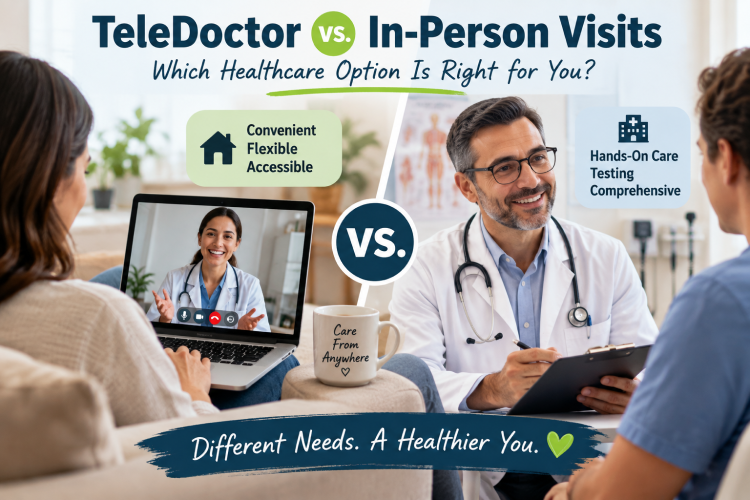
TeleDoctor vs. In-Person Visits: Which Healthcare Option Is Right for You?
Can you get the same quality of medical care from your couch as you can inside a doctor’s office? In many cases, TeleDoctor visits can be a convenient and effective choice, especially for routine follow-ups, minor illnesses, medication questions, and some chronic conditions. However, in-person care is still essential when a physical exam, testing, or urgent treatment is needed.
The best option depends on your symptoms, health needs, access, comfort, and the type of care required. Telehealth and in-person appointments are not really competing choices. Often, they work best together.
🩺 What Is A TeleDoctor Visit?
A TeleDoctor visit lets you talk with a healthcare professional remotely. You may connect through a video appointment, phone call, or secure online healthcare platform. Your provider can review symptoms, discuss medications, check your health history, and recommend the next step. Some services also support remote monitoring and follow-up care.
Telemedicine can make healthcare easier to access without requiring a trip to a clinic. It can be especially helpful when transportation, work, distance, or mobility makes office visits difficult. Research also suggests that virtual care can produce outcomes comparable with in-person care for many conditions, although results vary by medical situation.
💻 When TeleDoctor Care Makes More Sense
TeleDoctor care works particularly well when your provider does not need to physically examine you. For example, you might use a virtual appointment for a medication review, follow-up discussion, mild symptoms, or ongoing condition management. Mental health counseling is another area where virtual appointments can work well.
It can also save valuable time. You avoid commuting, parking, and sitting in a waiting room. For many routine healthcare needs, convenience is not just a luxury—it can make it easier to actually get care. Studies have found that virtual care may reduce missed appointments and improve access for some patients.
| Healthcare Need | TeleDoctor | In-Person |
| Medication discussion | ✅ Excellent | ✅ Good |
| Routine follow-up | ✅ Excellent | ✅ Excellent |
| Mental health visit | ✅ Often suitable | ✅ Suitable |
| Physical examination | ⚠️ Limited | ✅ Best |
| Emergency symptoms | ❌ Not appropriate | 🚨 Urgent care needed |
🏥 When An In-Person Visit Is Better
Some health problems simply require hands-on medical care. A doctor may need to listen to your heart and lungs, examine your abdomen, check swelling, inspect an injury, or perform another physical assessment. Blood tests, imaging, injections, and other procedures also require an appropriate healthcare setting.
In-person care can also reduce uncertainty when symptoms are complicated. If your provider cannot safely assess the problem through a screen, an office visit may be the smarter choice. Telehealth can still be part of the process, but your doctor may recommend an in-person appointment after the virtual consultation.
⚖️ TeleDoctor Vs. In-Person Visits: Key Differences
The biggest difference is how the provider gathers information. During an in-person visit, the clinician can combine your answers with a physical examination and on-site testing. During a TeleDoctor appointment, the provider mainly depends on your description, visual information, medical history, and available home measurements.
Neither option is automatically better for every patient. Evidence from recent reviews suggests telehealth can be comparable to traditional care across several clinical areas, but quality and safety can vary depending on the condition.
| Factor | TeleDoctor Visit | In-Person Visit |
| Convenience | ⭐⭐⭐⭐⭐ | ⭐⭐⭐ |
| Travel required | Usually no | Usually yes |
| Physical examination | Limited | Full |
| Lab testing | Usually separate | Often available |
| Privacy | Depends on location | Clinical setting |
| Best for emergencies | No | Yes, depending on severity |
💰 Which Option Can Save You Money?
TeleDoctor appointments may lower some of the costs connected with healthcare. You may spend less on transportation, parking, time away from work, or childcare. Some online services may also offer transparent appointment pricing, although costs vary widely between providers and insurance plans.
Still, cheaper does not always mean better. If a virtual appointment leads to an additional office visit because you need an examination, the total cost may be higher. Before booking, check your insurance coverage, copay, deductible, and whether follow-up testing is included.
⏱️ Why Convenience Matters More Than You Think
Healthcare is easier to use when it fits into your life. A virtual appointment may let you speak with a provider during a break at work or from home. This can be particularly useful for people who live far from medical offices or have difficulty traveling.
Convenience may also encourage people to seek care sooner. That matters because delaying a medical concern can sometimes make treatment more difficult. Telehealth research has found potential benefits involving timeliness, access, and missed-visit rates, although these benefits are not universal.
🧪 What TeleDoctor Cannot Do
A virtual appointment has obvious limits. Your provider cannot directly feel your abdomen, examine a wound with their hands, draw blood, take an X-ray, or perform many procedures through a computer screen. Even a high-quality video call cannot fully replace every part of a physical examination.
Technology can create other problems too. A weak internet connection, poor camera quality, limited digital skills, or difficulty using a healthcare platform can interrupt the appointment. Older adults and people with lower digital literacy may face additional barriers, making flexible care options important.
🌡️ Which Conditions Work Well With Telehealth?
Telehealth can be useful for many non-emergency situations. It is commonly considered for routine follow-ups, medication management, mental health support, some skin concerns, and certain chronic disease check-ins. Your provider can also help determine whether your symptoms require an office visit.
Virtual care may be especially useful when your health condition is already known and stable. For example, a follow-up conversation may not require another complete physical examination. Research on chronic disease care has found virtual models can have similar or favorable outcomes in several settings, although additional visits may sometimes be needed.
Common situations where TeleDoctor care may help include:
- Medication questions or refills
- Routine follow-up appointments
- Mental health counseling
- Some chronic condition management
- Minor, non-emergency concerns
- Reviewing test results
- General health questions
🚨 When You Should Choose Urgent In-Person Care
Do not use a routine TeleDoctor appointment as a substitute for emergency medical care. Severe chest pain, major breathing problems, signs of a stroke, severe bleeding, loss of consciousness, or other potentially life-threatening symptoms need immediate attention. In the U.S., call 911 for a medical emergency.
For less urgent problems, your healthcare provider may still recommend an office, urgent care, or emergency department visit. When in doubt, describe your symptoms clearly to a qualified medical professional and ask what level of care you need. The safest option is always the one that matches the seriousness of your symptoms.
🔄 Can You Use Both Types Of Healthcare?
Absolutely. In fact, a combination of telehealth and in-person care can often be the most practical approach. You might start with a virtual appointment, then visit the office if your provider needs to perform an examination or order testing.
This hybrid approach can reduce unnecessary travel while preserving access to hands-on medical care. For example, a virtual follow-up may be enough after an in-person diagnosis. Research increasingly supports using telehealth as part of broader healthcare delivery rather than treating it as a complete replacement for traditional visits.
| Situation | Better Starting Point | Possible Next Step |
| Medication follow-up | TeleDoctor | In-person if needed |
| Mild new symptoms | TeleDoctor | Testing or office visit |
| Routine chronic care | Either | Based on provider advice |
| Need for physical exam | In-person | Further testing |
| Severe or emergency symptoms | Emergency care | Hospital treatment |
🤔 How Should You Choose The Right Option?
Start by asking one simple question: “Does my provider need to physically examine me?” If the answer is probably no, telehealth may be a convenient starting point. If you need testing, a procedure, or hands-on assessment, an in-person visit is usually more appropriate.
You should also consider your comfort level and access to technology. Before booking, think about your symptoms, medical history, medications, home health measurements, and how quickly you need care. When you are unsure, contact the healthcare provider and explain what is happening rather than guessing.
A Simple Decision Checklist
- Is this an emergency? Seek immediate medical care.
- Do I need a physical examination? Choose in-person care.
- Is this routine or a follow-up? Telehealth may work.
- Will I need testing or a procedure? An office visit may be better.
- Am I unsure? Ask your healthcare provider which option fits.
🧠 What The Evidence Says About Telehealth
The research does not support a simple “telehealth is better” or “in-person care is better” answer. A large systematic review of U.S.-relevant studies found that differences in clinical outcomes between telehealth and in-person care were generally small or varied by clinical area. It also found lower missed-visit rates and better medication or therapy adherence in some telehealth settings.
The evidence also shows why context matters. A 2024 systematic review of video-based physical therapy found similar satisfaction and potentially better attendance and exercise adherence with tele-rehabilitation, but the researchers rated certainty from low to very low. Good healthcare is not about choosing the newest option; it is about choosing the appropriate option.
❤️ The Bottom Line: Which One Is Right For You?
So, TeleDoctor vs. in-person visits is not really a battle with one universal winner. Telehealth is excellent for convenience, follow-ups, medication discussions, mental health care, and some ongoing conditions. In-person appointments remain essential when you need a physical examination, diagnostic testing, procedures, or hands-on treatment.
The smartest choice depends on what you need from the appointment. If you can safely receive care remotely, TeleDoctor services may save time and make healthcare easier to access. If your condition requires physical assessment or urgent treatment, choose in-person care without delay.
When you’re unsure, let a healthcare professional help you decide. The right healthcare option is the one that provides appropriate care safely—not simply the one that is easiest.
❓ Frequently Asked Questions
Can TeleDoctor Diagnose Health Problems?
Yes, TeleDoctor providers can diagnose some conditions remotely. They use your symptoms, medical history, visual information, and available measurements. Some problems still require an in-person examination or testing.
Is TeleDoctor Cheaper Than In-Person Care?
It can be, but the cost depends on your provider and insurance. You may save money on transportation and time. Always check your copay and coverage before booking.
When Should I Choose In-Person Care?
Choose in-person care when you need a physical examination, testing, treatment, or a procedure. It is also important when symptoms cannot be safely assessed remotely. Emergency symptoms require immediate medical attention.
Is TeleDoctor Good For Chronic Conditions?
Telehealth can be useful for managing many stable chronic conditions. It can support follow-ups, medication reviews, and ongoing monitoring. Your provider may still schedule periodic in-person visits.
Can A TeleDoctor Visit Replace A Checkup?
Sometimes, but not always. Some routine discussions can happen virtually, while certain preventive services require physical exams or testing. Your healthcare provider can determine which parts of your care need an office visit.